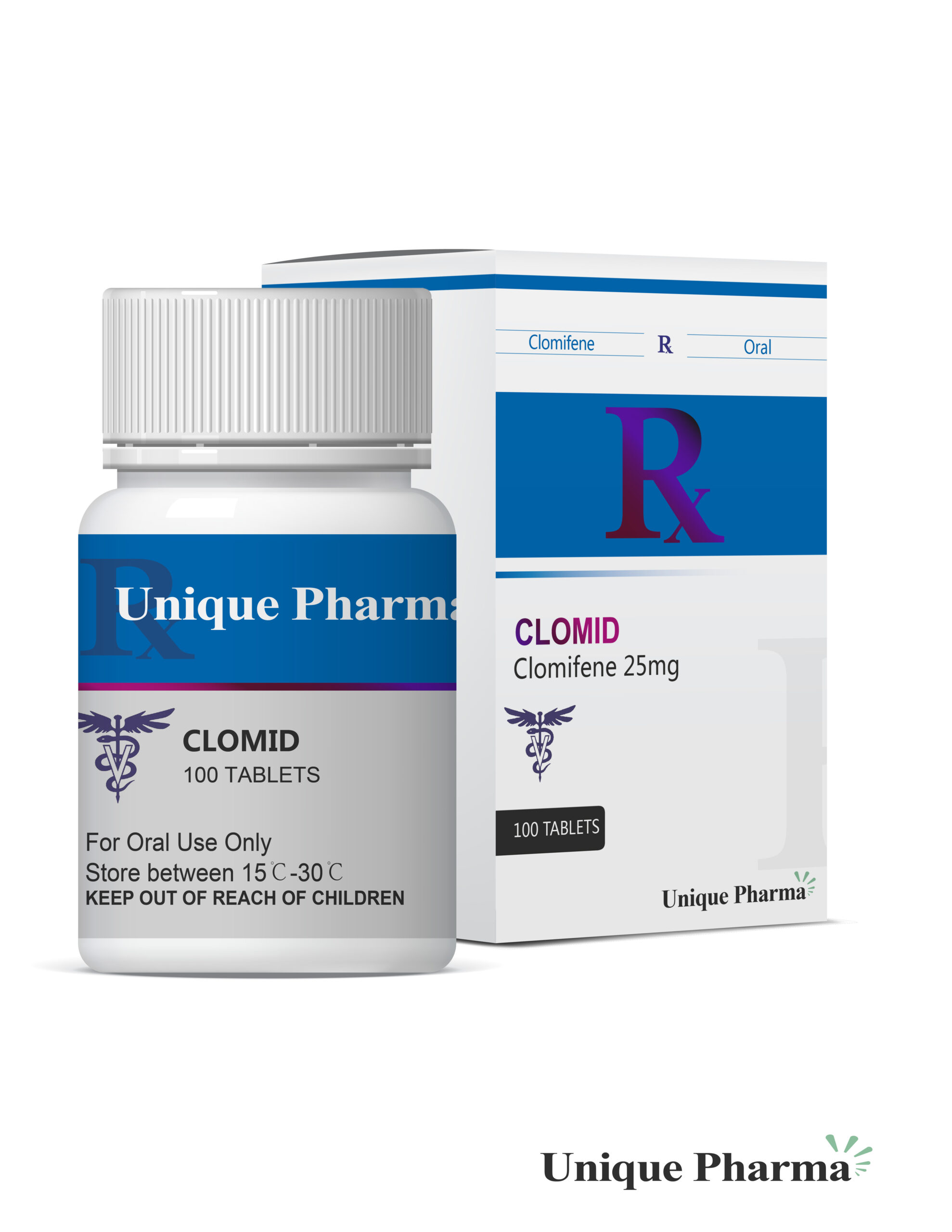
Clomid Unique 100x25mg
€ 40,00
| Title | Range | Discount |
|---|---|---|
| “Buy 2–3: €35 each” | 2 - 3 | € 35,00 |
| “Buy 4 or more: €30 each” | 4 + | € 30,00 |
Description
Clomiphene
Clomiphene is the active substance in the medication Clomid. Doctors prescribe Clomid as a fertility drug for women, but male pharmacological athletes typically use it after an anabolic steroid cycle to help restore natural testosterone production more quickly. In theory, clomiphene could indeed have that effect.
Clomiphene is an anti-estrogen that prevents glands in the brain from detecting female hormones. Since these glands partly use estrogen levels to determine how much testosterone the body should produce, clomiphene prompts them to release hormones that stimulate testosterone production in the testicles. However, whether steroid users truly recover faster due to clomiphene hasn’t been thoroughly researched.
Clomiphene also comes with its own side effects, including:
-
Blurred and/or double vision
-
Depression
-
Dizziness
-
Insomnia
-
Reduced liver function
Users may also experience temporary low moods or depression, a complaint that often arises after stopping anabolic steroid use.
How Does Clomid Work?
Clomid stimulates the hypothalamus, which in turn stimulates the pituitary gland to release gonadotropin-releasing hormone (GnRH). This hormone triggers the release of:
-
Luteinizing hormone (LH)
-
Follicle-stimulating hormone (FSH)
FSH stimulates the testicles to produce more testosterone, while LH stimulates them to release more testosterone. This entire process is known as the hypothalamic-pituitary-testicular axis (HPTA).
However, the effectiveness of the first step—stimulating the hypothalamus—depends heavily on estrogen. After a steroid cycle, when androgenic (masculinizing) hormone levels are very low (because the body’s natural production is shut down and external sources have stopped), the body compensates by producing extra estrogen. This presence of estrogen contributes to the total hormone level, tricking the body into thinking that hormone levels are still sufficient, and thus delaying testosterone production.
Clomid acts as an anti-estrogen, reducing estrogen activity (not the quantity!), so the body senses a hormonal deficiency and starts producing both testosterone and estrogen (with estrogen effectiveness reduced due to Clomid). For this reason, Clomid is not useful during a cycle as a testosterone booster—your testosterone is already elevated due to the steroids, and natural production remains suppressed.
Clomid is anti-estrogenic because, as a synthetic estrogen, it binds to estrogen receptors in cells, preventing natural estrogen in the blood from binding to them. The amount of estrogen does not decrease, but its effectiveness does. This can help reduce estrogen-related side effects such as gynecomastia and water retention, though Clomid’s effect here is relatively mild. Therefore, Clomid is not the first choice to counter these kinds of side effects. Nor is it the best option for PCT in all cases—but more on that later (see: Clomid or Nolvadex).
When Should You Start Clomid?
Since using Clomid during a steroid cycle is ineffective (due to the high levels of androgenic hormones), the timing of starting Clomid as PCT depends on the ester of the steroids used and the dosage.
The ester is a chemical compound attached to the anabolic-androgenic steroid (AAS) molecule that determines its half-life—the time it takes for the substance’s effectiveness in the blood to drop by half.
A table (not provided in your text) usually accompanies this section to show estimated start times for Clomid based on different AAS half-lives.


Reviews
There are no reviews yet.